2010 Philadelphia blizzard
I'd Like to Apologize to Every Teacher I Ever HadThe 2010 Philadelphia blizzard is significant not merely as severe weather but as an event that exposes how little margin the school year affords. Beginning at midnight after the class has reduced its poetry-contest field to ten remaining contestants, the storm suspends an educational sequence that had been building toward a final performance. Its immediate physical force becomes an institutional problem: every canceled day threatens the curriculum schedule, student preparation, and the school’s already precarious performance under the Pennsylvania System of School Assessment and Adequate Yearly Progress demands.
The Storm and Its Scale
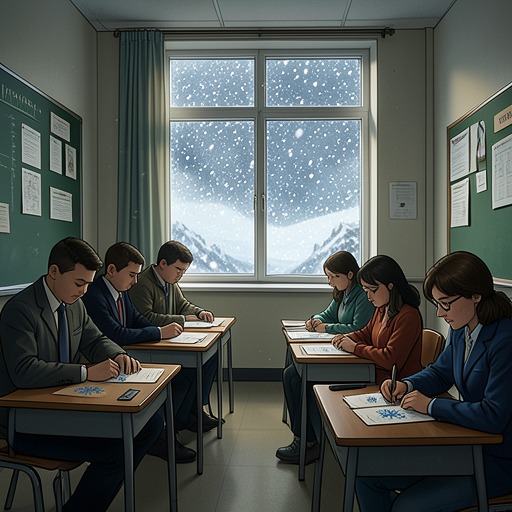
The blizzard begins after Friday’s class, before the ten remaining contestants are due to perform on Monday. More than seventy inches of snow falls on the city over the following week and a half, breaking all records. The weather therefore arrives at a precise narrative moment: the poetry contest has momentum, but the school calendar can no longer be treated as stable. The storm does not simply delay an ordinary lesson; it interrupts a competition whose close scoring requires continuity, memory, and repeated public performance.
The narrator contrasts the adult emergency with his childhood memory of snow days. As a child, he had regarded canceled school as freedom, lying awake to count the inches on the windowsill and waiting for an announcement that classes were closed. Neighborhood children built igloos, forts, and tunnels, played King of the Mountain, and ended snowball fights by covering cars with snow before running away. That recollection gives the blizzard an earlier emotional meaning, but the adult perspective reverses it. What once signified release now signifies accumulated obligation.
Lost Time and the Curriculum Clock
Watching the whiteout from home, the narrator thinks less about recreation than about how the class will make up the lost time. Teachers feel the curriculum clock ticking because they have only a fixed period in which to cover an extensive course. The storm threatens not only the days formally lost but also the momentum painstakingly created before the closure. The narrator assumes that students are unlikely to use their free time to catch up on schoolwork, so the class will return not merely delayed but behind its previous position.
That consequence produces a practical reversal when school finally reconvenes after a full week of snow days. The remaining students recite their poems, but the scores are so close that contestants who performed before the storm must repeat their poems. The contest consequently has to backtrack before it can advance. Al G refuses to repeat his performance, saying, “I’m not winning anyway,” and the narrator does not force him. The episode shows how the blizzard changes the terms of participation: continuity has been broken, confidence has shifted, and even a seemingly finished performance becomes provisional.
The Contest Resumes
After the interruption, the judges narrow the field to three finalists: Emmanuel performing Poe’s “Annabel Lee,” Janae performing Maya Angelou’s “Still I Rise,” and Daniel performing Sandra Tolson’s “He Sits Alone.” Because the results are tied, the principal becomes the final arbiter. Before the finalists perform, the narrator invites Al G to recite his poem for the principal despite the student’s hostile look. Al G performs well, and the narrator smirks at him for once. The blizzard has not erased the contest, but it has made the route to its conclusion more cumbersome, requiring repetition, renewed exposure, and an additional decision-maker.
The event also reveals the narrator’s changed relation to interruption. Childhood snow days were spontaneous communal adventures, while the teacher’s snow days are filled with calculation: what has been covered, what must be repeated, what students are doing, and how much more pressure will follow. The same snow can therefore produce pleasure in one stage of life and anxiety in another. Its force lies partly in this contrast between remembered freedom and present responsibility.
Accountability and Institutional Consequences
The blizzard gains further significance because Northeast High School is already operating under intense testing pressure. The statewide Pennsylvania System of School Assessment measures reading, writing, mathematics, and science in the junior year, while the state uses the results to judge each school’s overall Adequate Yearly Progress. Northeast High School failed to meet its Adequate Yearly Progress target in 2009, making the 2010 practice test and the real examination consequential for every class.
The school’s anxiety is tied to the threat of Renaissance School status. Ms. Carroll warns that failure to demonstrate progress could put all jobs at risk: Northeast High School could be classified as a failed school, taken over by the superintendent, staffed anew, and placed under a private contractor or even converted into a charter school. In that environment, snow days are not neutral interruptions. They reduce the time available to satisfy an external measure that may determine the school’s institutional survival, even though weather is outside the control of teachers and students.
When the real tests are later administered, Northeast High School improves in every category except writing but still fails to meet its Adequate Yearly Progress target. The school becomes an Empowerment School and moves closer to Renaissance School status, receiving additional professional-development meetings, district auditor walk-throughs, student assessments, and pressure to perform. Parents are notified that the school missed its target and may move their children elsewhere. The blizzard thus belongs to a larger chain in which lost instructional time feeds an already punitive accountability system, while the eventual result demonstrates that improvement itself may not be enough to satisfy the measure.
Narrative and Thematic Significance
As a narrative event, the 2010 Philadelphia blizzard converts an apparently external natural force into a test of the school’s institutional fragility. The storm’s record snowfall is dramatic, but the book’s deeper emphasis falls on delayed learning, interrupted preparation, and the unequal burden placed on teachers expected to recover time they never possessed. The weather becomes a visible image of pressures that are otherwise abstract: the ticking curriculum clock, the threat of district takeover, and the demand to make education entertaining and successful under conditions of scarcity.
The event also supports the book’s broader rejection of the blame game. Educators are expected to cover the curriculum, sustain student engagement, prepare students for high-stakes tests, and absorb disruptions without losing effectiveness. Yet the blizzard makes plain that the system has been designed with little capacity for contingency. By forcing the class to repeat work before proceeding, it dramatizes the gap between official expectations and the lived logistics of teaching. The storm ends, the contest continues, and the students perform, but the institutional pressure remains; the lost time has to be carried forward rather than simply recovered.